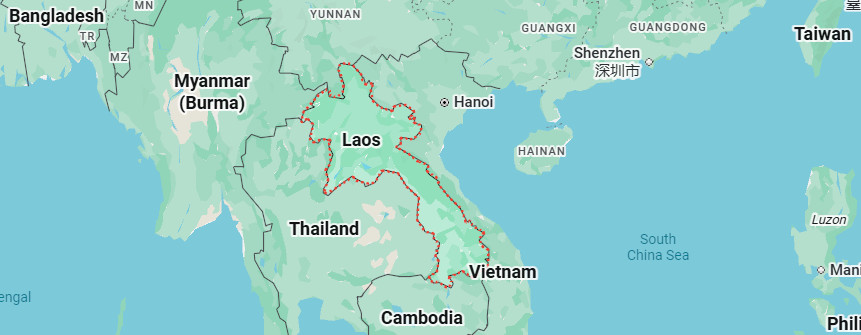
If I have to choose my most favorite Southeast Asian country, it will definitely be Laos.
Laos, a landlocked country surrounded by Vietnam, Cambodia, Thailand, Myanmar, and China, is one of the world’s few communist states. The former French colony got caught up in the Vietnam War that lasted some 20 years. Despite economic reforms and opening up to the world in the 1990s, the country remains poor and is heavily dependent on foreign aid. Most Laotians live in rural areas, with around 80% working in agriculture.
I started traveling from the capital Vientiane and worked my way north to Vang Vieng and Luang Prabang. Each city is about 4 hours apart and can be easily reached my taking buses or mini-vans. The cities are unique in their own way and the commute is always remarkably scenic (especially the route between Vang Vieng and Luang Prabang).
Much of Laos lacks adequate infrastructure: The country has no railways, except a short link to connect its capital Vientiane with Thailand over the Thai-Lao Friendship Bridge; that said, Laos has strong desires for developing hydro-power – The country has ambitious strategies to generate electricity from its rivers and selling the power to its neighboring countries.
#Laos

The park was built in 1958 by Luang Pu (Venerable Grandfather) Bunleua Sulilat, a priest-shaman who integrated Hinduism and Buddhism; 20 years later he built another sculpture park next to Thai-Lao border, this time on the Thai side, only a few kilometers apart from each other.
The Buddha Park can be reached by taking the public bus from Vientiane (takes approximately 1 hour). Near the entrance of the park is a giant pumpkin tower, which has 3 stories representing 3 levels – Hell, Earth, and Heaven. Visitors can enter through the mouth of the demon head and climb the staircases from Hell to Heaven, overlooking the entire park from the top of the pumpkin tower.
@Vientiane

Most males in Laos will be a monk at some point in their lives, and many rural families send their young sons to temples for a good education and better quality of life. Some remain monks all their lives, whilst others return home after a year or two.
@LuangPrabang

How could I resist? There was no other way to do the 26km loop without a motorbike. There is a reason why everyone has a motorbike here – This is the way of life.
Majority of the route was loose rocks so I was extremely cautious the entire time and drove very slowly. After stopping for hikes, lunch, and photo opps, the 26km ended up taking me the entire day.
@VangVieng

@LuangPrabang

@LuangPrabang

The park was built in 1958 by Luang Pu (Venerable Grandfather) Bunleua Sulilat, a priest-shaman who integrated Hinduism and Buddhism; 20 years later he built another sculpture park next to Thai-Lao border, this time on the Thai side, only a few kilometers apart from each other.
The Buddha Park can be reached by taking the public bus from Vientiane (takes approximately 1 hour). Near the entrance of the park is a giant pumpkin tower, which has 3 stories representing 3 levels – Hell, Earth, and Heaven. Visitors can enter through the mouth of the demon head and climb the staircases from Hell to Heaven, overlooking the entire park from the top of the pumpkin tower.
@Vientiane

20% of the bombs / unexplored ordnance (UXO) have still not explored and remain on the ground, contaminating villages and causing new casualties every year. Children are injured because the shape and color of the cluster bombs make them alluring to play with. The most impoverished and desperate are also injured because UXO contains copper and the scrap metal can be traded to supplement their low incomes.
UXO LAO, a government-run / UN-supported organization, runs clearance programs to remove bombs from contaminated lands throughout the country. UXO LAO removes and destroys 60,000+ UXO in a typical year. However, with existing resources, it will take at least 100 years to get rid of all the bombs.
@LuangPrabang

They might look unassuming at first sight, but man are they delicious! Warm coconut custard inside slightly crispy soft bread. OMG.
@LuangPrabang

They might look unassuming at first sight, but man are they delicious! Warm coconut custard inside slightly crispy soft bread. OMG.
@LuangPrabang

@LuangPrabang

@LuangPrabang

The statue depicts him in the act of bestowing a constitution upon the people.
@Vientiane

@Vientiane

Vientiane (the capital of Laos) is located next to the Lao-Thai border, which separates Laos from Thailand. The two countries are separated by Mekong River, which is only about 500 meters wide – You can technically swim across the river to get to the other country.
Of course, if you want to stay dry, taking the bus to enter Thailand over the Thai-Lao Friendship Bridge would be a good alternative.
@Vientiane

Most males in Laos will be a monk at some point in their lives, and many rural families send their young sons to temples for a good education and better quality of life. Some remain monks all their lives, whilst others return home after a year or two.
@LuangPrabang

Most males in Laos will be a monk at some point in their lives, and many rural families send their young sons to temples for a good education and better quality of life. Some remain monks all their lives, whilst others return home after a year or two.
@LuangPrabang

@LuangPrabang

@LuangPrabang

How could I resist? There was no other way to do the 26km loop without a motorbike. There is a reason why everyone has a motorbike here – This is the way of life.
Majority of the route was loose rocks so I was extremely cautious the entire time and drove very slowly. After stopping for hikes, lunch, and photo opps, the 26km ended up taking me the entire day.
@VangVieng

Their daily 9-11am / 5-7pm practice group was such a cool concept. Young people who come for 2-3 years end up speaking English better than college graduates.
@LuangPrabang

@LuangPrabang

@LuangPrabang

@LuangPrabang

@LuangPrabang

@LuangPrabang

Based on geographical distribution, Laos has 3 main Ethnic groups: Loum (inhabitants of lowlands), Theung (inhabitants of mountain slopes), and Soung (inhabitants of mountain summits). This classification is somewhat oversimplified because, for instance, many Hmong are considered highland people but have settled in lowland towns.
Based on language and traditions, Laos has 4 main Ethnic groups: Austroasiatic, Hmong-Yao, Tai-Kadai, and Sino-Tibetan.
@LuangPrabang

The Hmong has a significant diaspora across the world. For instance, there are over 300,000 in the US alone. I have a couple of Hmong friends in the US so learning a little bit about their history seems quite fascinating and relatable.
@LuangPrabang

@VangVieng

The park was built in 1958 by Luang Pu (Venerable Grandfather) Bunleua Sulilat, a priest-shaman who integrated Hinduism and Buddhism; 20 years later he built another sculpture park next to Thai-Lao border, this time on the Thai side, only a few kilometers apart from each other.
The Buddha Park can be reached by taking the public bus from Vientiane (takes approximately 1 hour). Near the entrance of the park is a giant pumpkin tower, which has 3 stories representing 3 levels – Hell, Earth, and Heaven. Visitors can enter through the mouth of the demon head and climb the staircases from Hell to Heaven, overlooking the entire park from the top of the pumpkin tower.
@Vientiane

@VangVieng

@VangVieng

@VangVieng

@VangVieng

@LuangPrabang

@LuangPrabang

@LuangPrabang

@LuangPrabang

@VangVieng

@LuangPrabang

@LuangPrabang

@LuangPrabang

@VangVieng

@Vientiane

@LuangPrabang

@LuangPrabang

@VangVieng


@Vientiane

@LuangPrabang

@LuangPrabang

@LuangPrabang

@LuangPrabang

20% of the bombs / unexplored ordnance (UXO) have still not explored and remain on the ground, contaminating villages and causing new casualties every year. Children are injured because the shape and color of the cluster bombs make them alluring to play with. The most impoverished and desperate are also injured because UXO contains copper and the scrap metal can be traded to supplement their low incomes.
UXO LAO, a government-run / UN-supported organization, runs clearance programs to remove bombs from contaminated lands throughout the country. UXO LAO removes and destroys 60,000+ UXO in a typical year. However, with existing resources, it will take at least 100 years to get rid of all the bombs.
@LuangPrabang